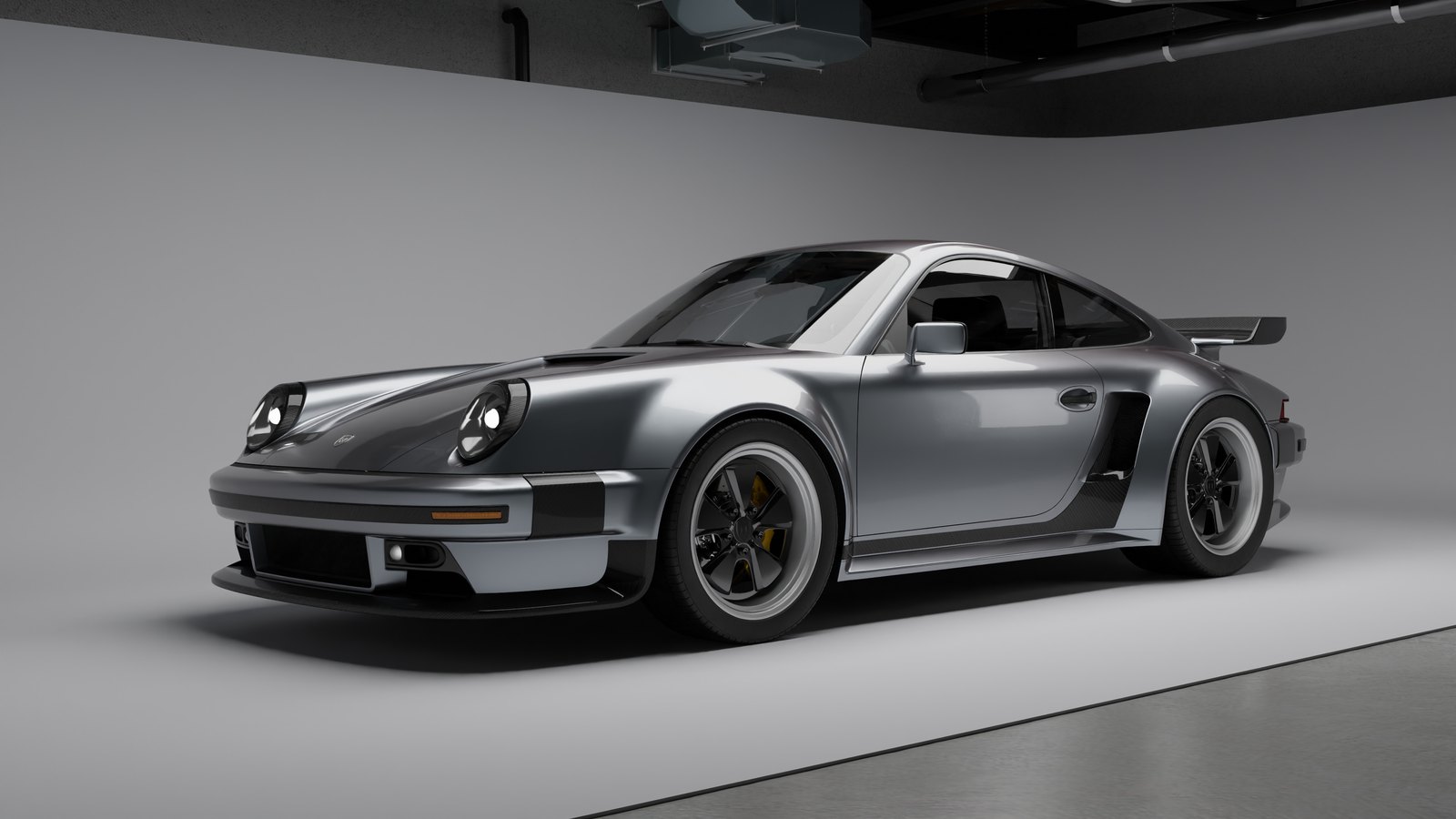
The 930 defined Porsche's Le Mans–inspired era: wild, fast, and dangerous, with its tea tray spoiler, wide rear, and boxy aggression. Famously called the "widow maker," it was unforgiving and unforgettable, a symbol of analog rebellion.
The Interpretation · Sanctum P74
Sanctum starts with the 997.1 Turbo, Porsche's last truly analog, twin-turbocharged AWD platform, powered by the legendary Mezger engine, a Le Mans–proven masterpiece. Then we re-interpret it visually, emotionally, viscerally to become a modern expression of the original 930 Turbo legend.
Car 00
The first build.
The reference Sanctum P74, the car against which every commission is measured.
The Process
From Blueprint to Breathless
One bolt at a time.
Every Sanctum P74 is built in California, where paint, engine and engineering work side by side under one roof. Nothing leaves the building until it is right.
01
Define the Vision
We sit down with you and go deep. Performance targets, aesthetic direction, daily-driver requirements, every detail of your ideal build is mapped before a single wrench is touched. This isn't a spec sheet; it's a blueprint for a machine that's unmistakably yours.
02
Source & Acquire
We locate and secure the right donor, evaluating provenance, condition, and potential with a trained eye. Whether you already own the car or we help you find and acquire it, the car is always yours, titled in your name, and we take on only vehicles worthy of the work ahead.
03
Mechanical Foundation
A stunning exterior means nothing on a compromised foundation. Every car begins with a full mechanical audit and restoration, drivetrain to suspension, then a performance upgrade from 600 HP up to 800 HP.
Every panel is bespoke dry carbon, fascias, skirts, fenders, hood, engine lid, in the Sanctum P74 form language. Only the doors and roof carry over. The result sits +5.8% wider and +0.8% longer than stock, on forged Fuchs-inspired rims with wider rubber. Custom design and manufacture of front turn signals and rear lights.
05
Interior Craftsmanship
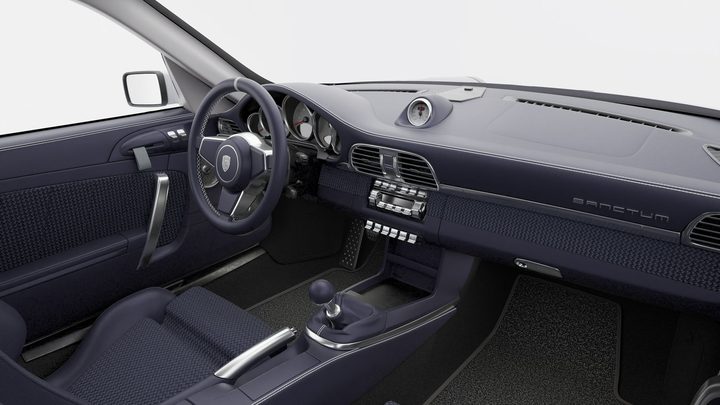
Recaro seats in the customer's choice of leather or technical fabric. Custom door cards, bespoke carpet, and a Sanctum-original center console with machined controls that feel nothing like a production car. A custom wheel, bespoke pedals, and an upgraded sound system, so the cabin matches the engine.
06
The Signature Finish
Paint is the final statement. Our custom paint process begins with a blank-canvas preparation and ends with a multi-stage finish, unique color formulation, flawless application, and protective coating, that makes the car impossible to ignore.
Dimensions
A widened silhouette.
The Sanctum P74, measured against the 997.1 Turbo donor, every edge pushed outward.
930 TurboSanctum P74997.1 Turbo
From above: the 930 that inspired it, the Sanctum P74, and the 997.1 Turbo it is built on. The soul of one, the engineering of the other, wider than both.
Lineage
Wider than any 911.
Measured in millimeters, against the lineage that came before it.
↔Hover over or tap any model to see how much larger the Sanctum P74 is.
Model
Length
Width
Height
Porsche 930 Turbo1974 – 1989
4,291+279 mm
1,775+235 mm
1,320−20 mm
Porsche 997.1 Turbothe donor platform
4,450+120 mm
1,852+158 mm
1,3000 mm
Porsche 992.2 Turbotoday
4,535+35 mm
1,900+110 mm
1,303−3 mm
Porsche 992.2 Turbo Stoday, flagship
4,552+18 mm
1,900+110 mm
1,306−6 mm
Sanctum P74 Turboevery commission
4,570
2,010
1,300
+120 mm longer, +158 mm wider than the 997.1 donor. Identical in height. The Sanctum P74 stands wider than any 911 Porsche has ever built.
Specifications
Sanctum P74’s engineering and performance.
Final specification is determined in conversation with each owner. The following is indicative, a starting point for a longer dialogue.
Powertrain
Configuration
Flat-six, twin-turbocharged · Mezger
Displacement
3.6 liters
Output
480 HP at 6,000 rpm · upgradable from 600 HP up to 800 HP
Torque
457 lb-ft at 1,950 rpm
Induction
Variable Turbine Geometry
What it is. Each turbocharger has a ring of adjustable guide vanes around the turbine wheel. At low revs the vanes close down, speeding the exhaust flow so the turbo spools almost instantly; at high revs they open wide for maximum flow. One turbo behaves like a small one and a large one at once.
Why it matters. The 997.1 Turbo was the first petrol production car to use it. Diesels had VTG for years, but petrol exhaust runs near 1,000 °C, so Porsche and BorgWarner turned to aerospace-grade materials to make it survive. The result is full torque from 1,950 rpm, little lag, and the effortless, linear shove that defines the Mezger Turbo.
Versus the air-cooled alternatives. Most air-cooled restomods rely on large naturally aspirated flat-sixes. They are glorious at 7,000 rpm, but their peak torque arrives well above 5,000 rpm, so the car has to be wrung out to feel fast. The Sanctum P74 delivers considerably more torque from under 2,000 rpm, so it pulls hard from any speed in any gear without a downshift. Its water-cooled Mezger also holds steady temperatures in summer traffic and on track, where an air-cooled engine starts to heat-soak. Classic character, without the classic compromises.
Transmission
Six-speed manual · Tiptronic automatic available
Drive
All-wheel
Exhaust
Sanctum, built in-house · valved · stainless, titanium or Inconel
Chassis
Body
Autoclave carbon composite, hand-laid
What it is. Sheets of prepreg, carbon fiber already impregnated with a precisely measured resin, are hand-laid into metal molds, sealed under vacuum, then cured in an autoclave: a pressurized oven running at roughly 120–180 °C and around 6 bar.
How it compares. Most aftermarket carbon is wet lay-up, resin brushed onto dry cloth, or vacuum infusion, resin drawn through it under vacuum. Both cure without pressure, so resin content varies and tiny air voids remain. Autoclave pressure compacts the laminate to around 55–60% fiber by volume, against 45–50% for the others, with near-zero voids.
Why it matters. More fiber and less resin means the strongest, stiffest panel for its weight, consistent thickness from part to part, and a flawless weave with no pinholes or distortion. The pressure is also why our molds are machined from metal: composite tooling cannot hold its shape through repeated autoclave cycles. It is the process used in Formula 1 and by McLaren and Pagani, not the panel trade.
Suspension
MCS 3-Way, remote reservoir, fully adjustable
Brakes
Carbon-ceramic, optional
Wheels
Custom Fuchs-Inspired Forged Aluminum · 19-inch
Tires
Michelin Pilot Sport Cup 2 Front: 265/35 ZR19, up from the stock 235/35 Rear: 325/30 ZR19, up from the stock 305/30
Cabin
Upholstery
Owner's selection, to sample
Seats
Recaro Classic or customer choice
Instruments
Mechanical, illuminated
Sound
On request
Infotainment
Modern, concealed
Commission
Built in
California
Total series
60 commissions
Build period
12 to 18 months, depending on level of customization
Donor
997.1 Turbo, manual or Tiptronic, selected with owner
Pricing
In line with other Porsche restomod commissions, plus your donor car
Figures shown are representative of a typical commission. Every Sanctum P74 is the owner’s own 997.1 Turbo, restored and modified to their specification; final weights, outputs, and configurations are agreed during the commissioning brief and may differ from those indicated above.
Performance
Everything You Need. Nothing You Don't.
ECU
Softronic calibration raises output from 600 hp up to 800 hp, with safeguards engineered for sustained, real-world use.
Turbo / Cooling
Upgraded K24 turbos, a Speedtech high-flow intake plenum and uprated intercoolers, with CSF radiators and new cooling hoses. Decisive response and the unmistakable Mezger character at the top of the rev range.
Brakes
GiroDisc GT3 Cup rotors paired with motorsport-grade pads, sized for repeatable stopping power without compromise.
Suspension
MCS 3-Way remote-reservoir dampers with independent high-speed compression, low-speed compression, and rebound, tuned to the Sanctum P74's geometry for composure on the road and authority on the circuit.
Clutch / Transmission
BBI lightweight flywheel and reinforced clutch mated to a refurbished six-speed manual, mechanical and exact.
Exhaust
Designed, fabricated and assembled in-house by Sanctum, in stainless steel, titanium or Inconel. An X-pipe with high-flow catalysts, an electronic valve with a quiet mode for the garage and early mornings, and Sanctum-designed tips, made in-house. Lighter than the original system, and tuned for a deep, period-correct voice that rises from a measured idle to the unmistakable flat-six wail.
Paint to sample
Heritage Palette
A few of our colors, each shown on the P74 in the same studio light. The full palette opens in your Commissioning Brief, or bring us your own. Full paint to sample is available: any historic Porsche code, a shade from a car you once loved, or a color that exists nowhere else, matched exactly.
The interior is just as much yours. The cabin shown beside each color is one example of how they can pair: leather, fabric, stitching and trim are all chosen with you in your Commissioning Brief.
Shown withCobalt Blue · Woven Leather
GT Silver Metallic
METALLIC
Classic silver, darker in the studio light.
Shown: a few examples. The full palette of thirty-eight, paint to sample, and every interior combination are part of your Commissioning Brief.
Archive
From a recent build.
A selection of images from the workshop, drawn from the archive of a Sanctum P74 currently in its final months, from donor car to finished detail.
IThe donor
IICarbon bodywork
IIICooling & mechanical
IVComing together
VInterior
Commission
Build Around You. And Only You.
We are building something special, quietly and intentionally. Just a limited number of owners’ cars each year, each restored and re-imagined to its owner’s specification. Six-speed manual or Tiptronic automatic, paint, trim and output: every choice is yours. No mass production. No showroom lines.
If you are considering a Sanctum P74, it starts with a conversation. Tell us about the car you have in mind, and we’ll take it from there.
Private viewings at our workshop in the Bay Area, California, by appointment.
All inquiries are held in strict confidence. We do not publish the names of our owners without their permission.